The Alternate You Test
Disclaimer: This post is an AI-assisted, reflective thought experiment. It is not legal advice, mediation, or a substitute for professional acoustic assessment. Its purpose is to explore shared-building sound with perspective and practical agency.
The Thought Experiment
Imagine you are the upstairs neighbour.
You either:
Work night shifts and shower at 11:30pm.
Have a toddler learning to run.
Just started tap lessons in your living room.
Moved in last week and don’t yet know what sound carries.
Now pause.
How would you hope someone downstairs interprets your sounds?
As carelessness?
Or as life happening in a building not designed for silence?
What’s Actually Happening?
In multi-dwelling buildings:
Footsteps are impact sound. They travel through structure.
Plumbing travels vertically through shared pipe channels.
Low-frequency thuds carry further than expected.
A dropped object can sound heavier below than above.
Most of this is physics — not personality.
Reality Frame
In buildings, sound does not equal intent.
Shared walls mean shared structure.
And shared structure means shared transmission.
Your Agency
You can’t control the building’s design.
But you do have options.
Suggestions and ideas:
White noise or sound masking at night
Soft furnishings to reduce echo in your own unit
Calmly asking about quiet hours
Clarifying if something specific is recurring
Sharing what sound carries in your own unit
Approach for information, not accusation.
Final Thoughts
Shared living is imperfect.
The goal isn’t silence.
It’s sustainability.
You’re allowed to regulate.
You’re allowed to seek environments that suit your nervous system.
And you’re allowed to remember that some sounds are simply evidence of other humans existing nearby.
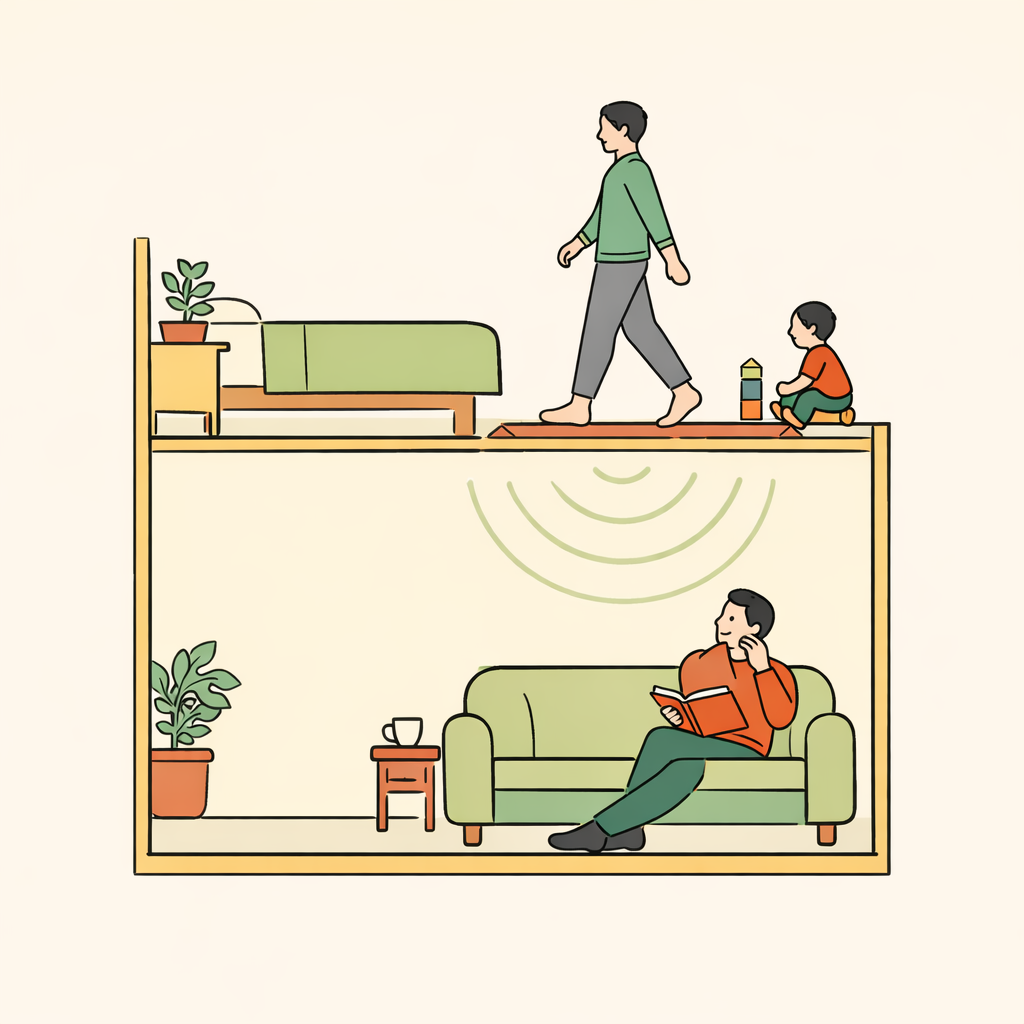
Impact sound is part of shared living.
Understanding it changes how we respond.