The 30-Day Sound Diary
Disclaimer: This post is an AI-assisted, reflective thought experiment. It is not legal advice, mediation, or a substitute for professional acoustic assessment. Its purpose is to explore shared-building sound with perspective and practical agency.
The Thought Experiment
Before signing a lease, imagine you’ve already lived here for 30 days.
Not perfectly. Just… normally.
Day 3
You hear footsteps above you at 6am.
Not loud. Just present.
What story forms first?Day 10
A TV murmurs through the wall in the evening.
You can’t make out words.
Does it feel like background… or intrusion?Day 18
You have a friend over. You laugh.
Then you pause.
Are you aware of being heard?Day 27
The sounds haven’t changed much.
But your body has.
Do they now feel predictable… or cumulative?
Now zoom out.
Across those 30 days —
was it the volume that shaped your experience…
or the meaning you attached to it over time?
And quietly, without pressure:
What level of unpredictability feels tolerable to you?
What’s Actually Happening?
Footsteps = impact sound travelling through structure
TV = airborne sound softening through walls
Awareness of your own noise = shared acoustic feedback loop
Buildings carry behaviour. Not intention.
Reality Frame
Shared walls mean shared physics.
Sound moving through a building is not a signal of who someone is.
It’s a property of how the space is built.
Your Agency
Micro (today, within your space)
Add soft layers (rugs, curtains)
Use low, steady background sound
Shift where you rest or work
Structural (before or beyond this space)
Prioritise top-floor or corner units
Ask about building type/materials
Treat sound tolerance as a core housing criterion, not a bonus
Final Thoughts
Nothing here is “too sensitive.”
Nothing here is “just noise.”
It’s information.
Over time, your nervous system learns a place.
The goal isn’t silence — it’s sustainability.
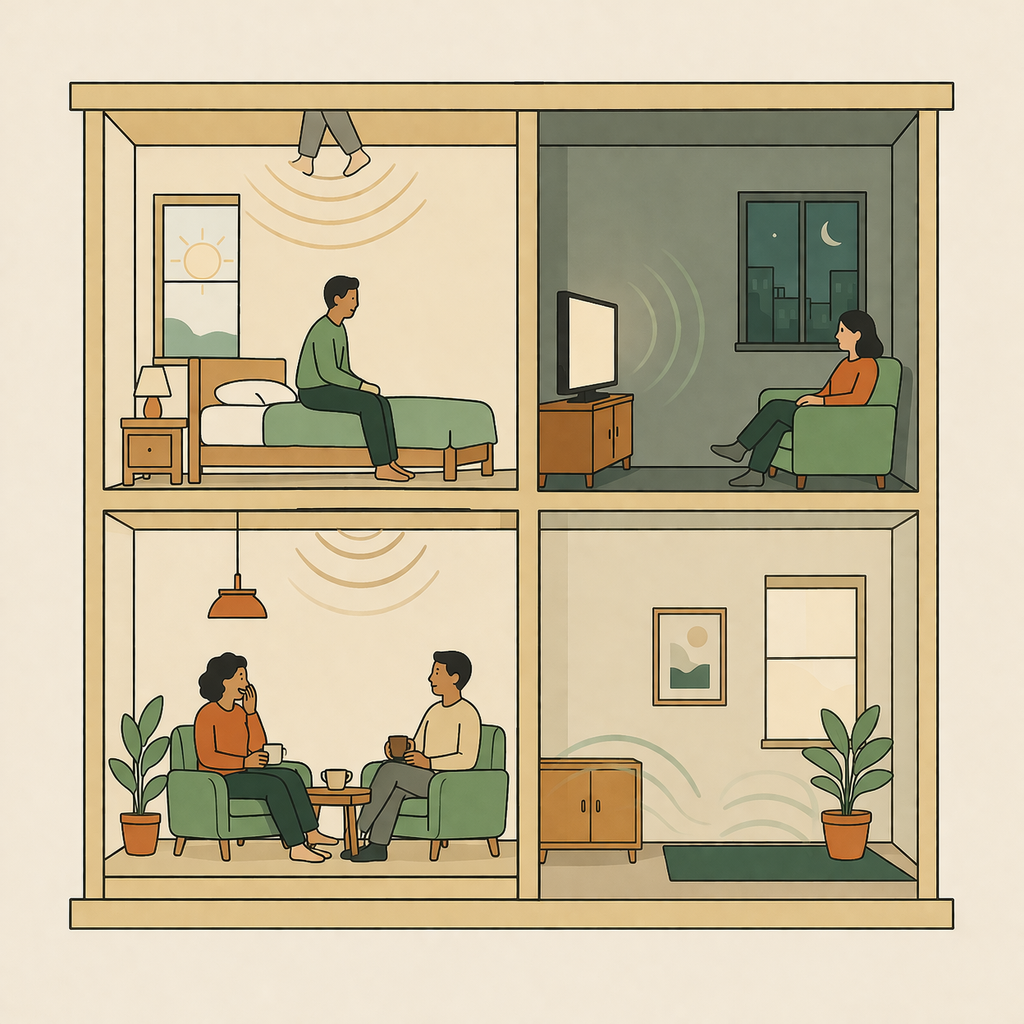
Flat illustration of four apartment units in cross-section, showing everyday moments across time—morning, evening, conversation, and quiet stillness—with soft curved lines illustrating sound traveling gently through walls and floors.