The Sound Budget
Disclaimer: This post is an AI-assisted, reflective thought experiment. It is not legal advice, mediation, or a substitute for professional acoustic assessment. Its purpose is to explore shared-building sound with perspective and practical agency.
The Thought Experiment
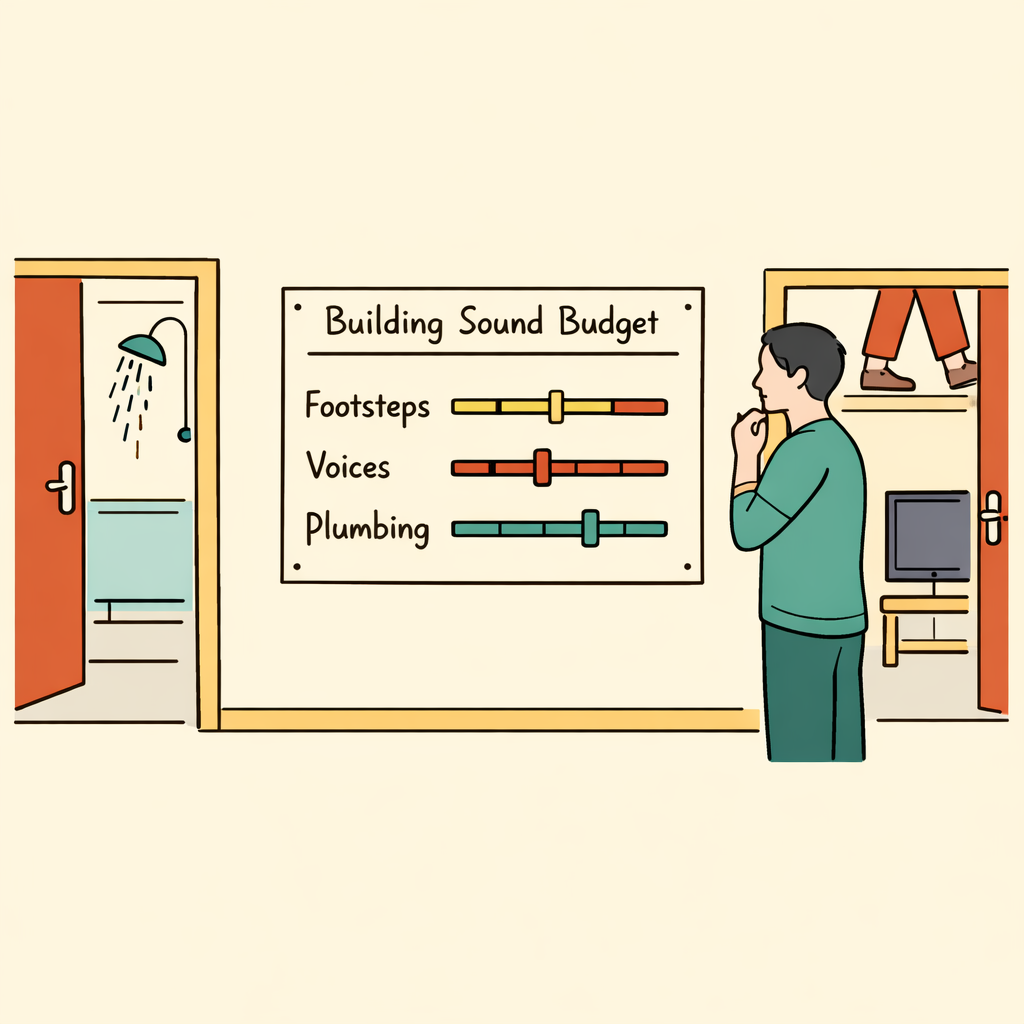
Imagine every building comes with a fixed sound budget.
You don’t get silence.
You get allocation.
20 units of impact noise
15 units of voice bleed
10 units of plumbing
You can’t eliminate categories. You can only redistribute them.
Would you spend more on soft footsteps but accept louder showers?
Would you prefer consistent low-level hum over occasional sharp bangs?
Would you trade quiet mornings for busier evenings?
If sound were a budgeting exercise instead of a battle, what would you choose?
What’s Actually Happening?
Different sounds travel differently.
Impact noise (footsteps, dropped objects) moves through structure — floors, beams, joists.
Airborne sound (voices, TV) travels through air and weak points in walls.
Plumbing often runs vertically, which is why water noise tends to move up and down more than sideways.
Buildings are rarely designed to eliminate all three equally. Improvements in one area can sometimes leave another unchanged.
Sound control is usually about distribution, not total removal.
Reality Frame
In shared buildings, sound does not equal intent.
Most everyday noise is a by-product of movement, gravity, and water pressure — not personality.
Shared walls mean shared physics.
Your Agency
You can manage your experience of the building’s sound budget.
Suggestions and ideas:
White noise or steady background sound to reduce contrast
Rearranging furniture away from shared walls
Rugs or soft furnishings to absorb internal echo
Earplugs for predictable sleep windows
Sometimes reducing unpredictability matters more than reducing volume.
You’re allowed to notice what affects your nervous system.
You’re also allowed to make housing decisions that support it.